
Project planning in the early years of AI requires a shift in mindset
Published:
THIS POST IS CURRENTLY UNDER CONSTRUCTION
Not only is the rapid increase of AI capabilities changing _how we work, it is also changing how we think about work. In this post, I will highlight an important way in which I have changed my mindset when it comes to planning and prioritizing work. In the old days (all of 8 months ago at the time of this writing), the key question one needed to answer when it came to planning a project was how much could one produce given the available resource. In the age of AI, the calculus has changed; generating output is extremely cheap. But generating high quality output is still expensive. We now must consider two dimensions rather than one: quantity and quality. Any given project must be defined with respect to both dimensions simultaneously._
Introduction
Before AI, when planning a project, the key dimension to be considered was quantity
In the old days (all of 8 months ago at the time of this writing), when someone went about planning a project, they would estimate how big of a project they could complete given the resources allocated to them. By “project” here, I mean any kind of knowledge-based product that someone or some team needs to produce: an article, a computer program, an image, etc. For most professionals, or experts in their field, the quality of work is often relatively stable. Therefore, if you ask an expert to produce a project
If you ask a professional software engineer, or team of engineers, to create a program, the question would rarely be, “How robust should the program be?” Or, “How clean should the code be?” Rather, the questions would be more like, “How many features should this product have?” If you ask a data scientist to perform a data analysis, the question would rarely be, “How correct should these conclusions be?” Instead, it would be more along the lines of, “How many questions do we seek to answer?”
Because quality, in most cases, is a relatively stable property of the output of human experts, the dimension most often considered was that of quantity. That is, the relationship between effort and quantity was, at a rough pass, linear: The more work I put in, the more stuff I can accomplish. This is illustrated schematically below:
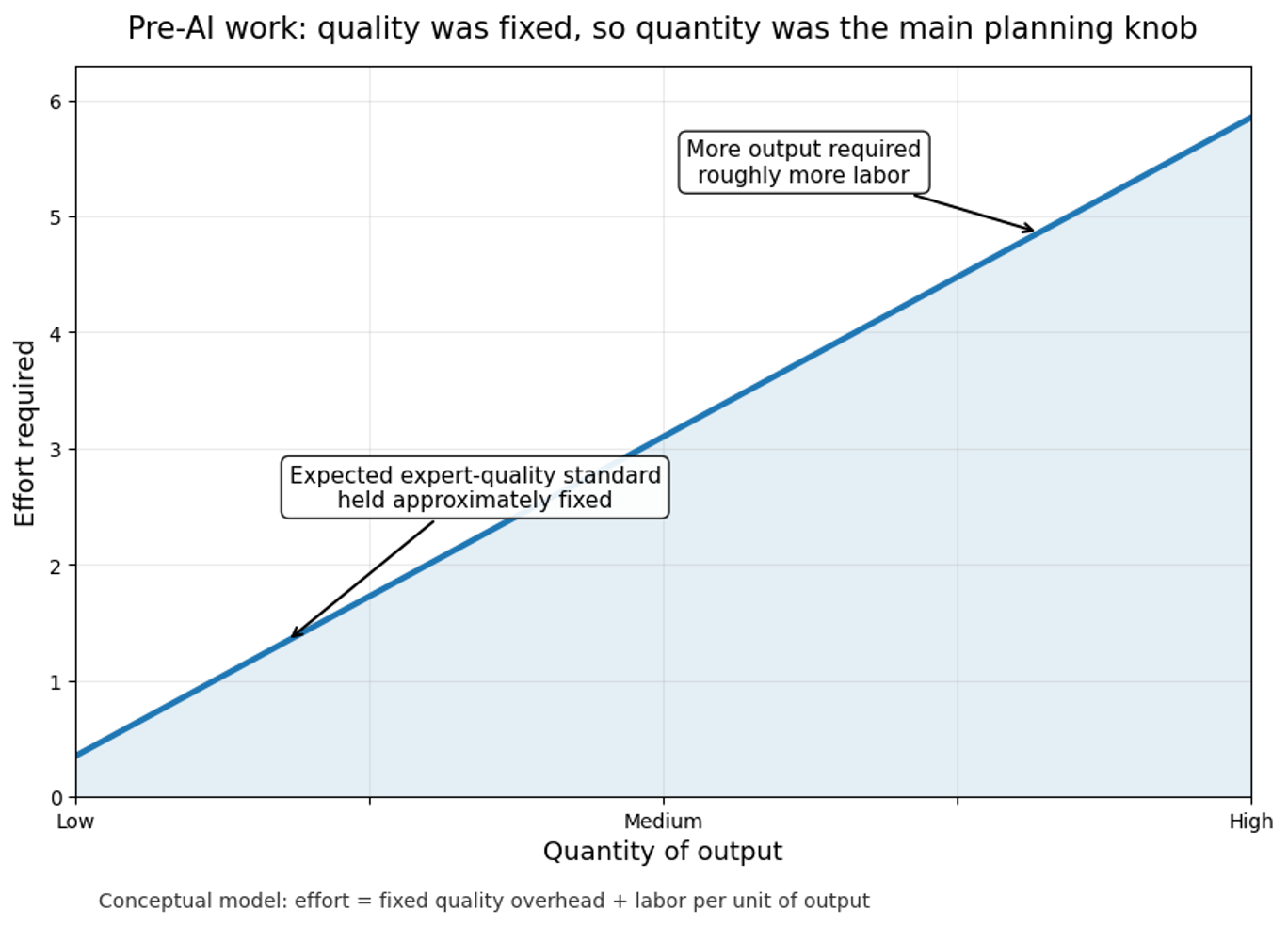
This mental model now requires revision in the age of AI.
In the age of AI, we now must consider a second dimension: quality
As of the time of this writing (September 13, 2026), AI models are capable enough to perform most knowledge work at a reasonable level; however, for the vast majority of tasks, models still lack the nuanced judgement and taste that an expert would possess. They miss the point, write with unnatural syntax, add features that are not necessary, or make assumptions that are not obvious, but that affect the result. That is, without human guidance, much of what they produce is slop.
Unfortunately, closing the gap between what an AI produces and what an expert deems to be at their acceptable level of quality still takes a lot of effort to close! I find this in my own work. As a machine learning scientist and computational biologist, I am now using AI to create analyses, write reports, and create presentations. In my personal experience, the quality of the output is somewhere in the ballpark range of 75% of what I would produce (outside of sheer of ability to write code and do math). I find that it takes quite a lot of time to tweak the writing, to remove unnecessary features in its code, to clean its figures, etc.
The calculus now has completely changed. No longer is quantity the dimension along which I plan, but more often than not, it is quality. Generating many, many projects at 75% quality is extremely cheap. But closing the quality gap is still quite expensive.